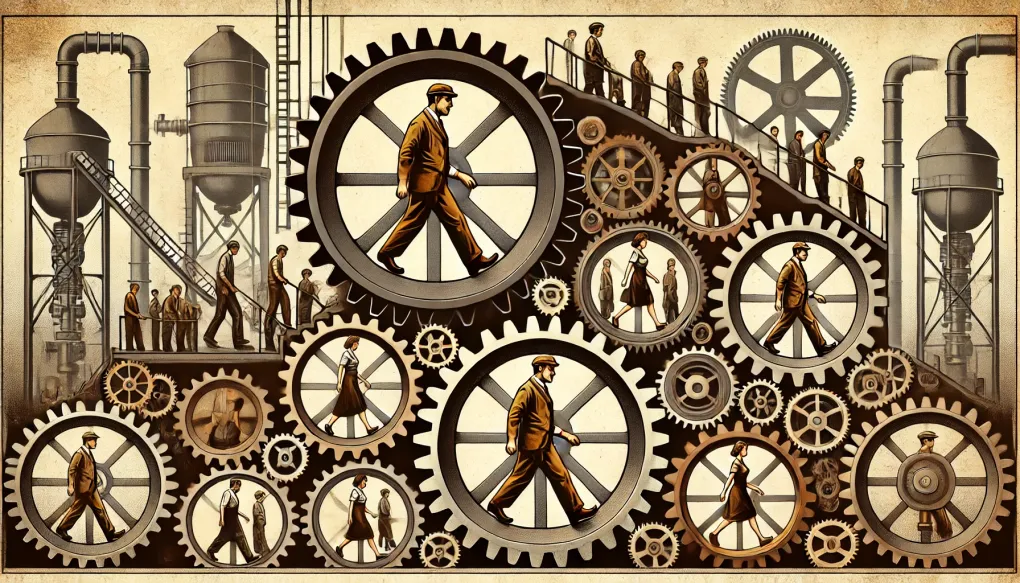
Just a cog in the machine
I don’t want to be a cog in the machine. Have I ever worked in a factory on an assembly line? No. Have I ever had to work in a fast food restaurant where you have a specific task that has been designed for efficiency? No. I’ve had the fortune to never needing to fall back to those types of jobs, where you are just a warm body filling a role that can be easily replaced by another person. Luckily, the world is slowly moving away from humans performing those jobs in favor of robotic automation. Which from a health and safety standpoint, there are benefits of not working with heavy machinery, but the economics is not so black and white. However, there is a new kind of machine that asks for “butts in seats” and has inklings of the assembly line feel… software development.
Some of the largest software companies in the world churn out an incredible amount of products and features. They have systems and processes in place that keep things moving along seemingly indefinitely. They lay off large percentages of their workforce and don’t seem to skip a beat (at least that’s the perception). People leave the company and just get replaced like cogs in a machine. Sure, there is some ramp up time where the new employee has to get greased up to fit in smoothly, but things keep churning along despite any attrition issues. Feels familiar, right? Is every company like this? No. Is it really so black and white? Probably not. But the way it can feel as an employee can that way. It seems like you can get your job just as easy as you can lose it. The company needs to cut costs, and the most expensive part of almost every company is the human capital. Cut some people to meet some financial goals and then just find more people when you need them later. As a whole, the company barely notices. The individuals take the brunt of the problem. One person gets let go and has to find a new job. That sucks (especially in the job market as of the writing of this post). The other people on that person’s team now has to pick up the extra work that person was doing. That sucks too. And that’s just from one person on one team. Extrapolate that out to 100 or 1000 people across an entire organization in these large RIFs (reduction in force), and you start to wonder how much the company is really being affected by that. But it was for the sake of the quarterly financials, so things can’t be that bad, right?
I know, I’ve painted a pretty grim picture, but there is always nuance. That isn’t a perfect representation of every company or every situation. But you see it time and time again on social media (mostly LinkedIn), “Hey everyone. I got let go from a RIF. Looking for a job. Reach out if you have any opportunities.” Right now, that same person is posting some version of that for months on end. Some people find new jobs right away through their network, and that’s great. Others don’t. They end up in stressful financial situations with a lack of income and a lack of insurance. If you are younger and don’t have a lot of responsibilities, maybe that’s okay for a short time. I know in my life though, those are very important. I have a daughter with a complicated medical history. Going a single day without medical insurance in the US is not an option for us (and I can’t believe that’s the case, but let’s not open that can of worms).
I’m not about to sell you on some big “here’s the solution to your problems” idea. I’m just explaining what works for me. I don’t want to be a cog. I want to be a part of something bigger than myself, but I don’t just want to fit into some replaceable role in a machine. Sure, everyone is “replaceable” to a certain degree. People have similar skill sets. However, that’s not the same as just being a developer in some structured process for churning out software products and features. Getting to have a say in the process is part of it. Being able to help out with sales and marketing as a developer can be a great learning experience. Getting to really help shape the product, not just code solutions outlined in Jira tickets, is energizing. At least, that’s what I want. Given I’ve always wanted to start my own business, learning the other facets of running a company is really important. That’s a large part of the reason I’ve been working in startups for the past 5 years. You get to do more than just the job description.
For some people, the steady paycheck and consistent workload is perfect (assuming you don’t get laid off, sorry I’m being grim again). If I’m honest with myself, there are times when that sounds highly appealing (usually when I’m stressed out trying to balance family time with work, friends, side projects, etc). Having to deal with everything that results from medical issues with your child takes its toll. The appointments with specialists for the various issues (of which I can’t possibly list in a single paragraph). Working with therapists to be sure she stays on track with her physical, occupational, and speech/eating development. Sitting in waiting rooms for multiple surgeries (however minor), and anticipating upcoming major ones like a kidney transplant. But none of that compares to how we got here (premature birth and 4 months in the NICU). My wife is managing a lot of the logistics, medications, calls with insurance, appointments, and etc. That has its own stress associated with it (accompanied with the guilt of my not always being able to be there for every appointment). I seriously can’t thank her enough, but she usually reads these, so maybe this will help. But let’s get back to the cog analogy.
I wrote most of this blog post weeks before finishing it. Since then, the cog idea has been bouncing around in my head. Startups have a different kind of system of cogs. How people come together to build something is still a system of integrated cogs. It’s more flexible. The gears aren’t exactly perfectly structured, and sometimes don’t fit well together, but they churn something out. In some cases, they fit in a way that produces something magical, or produces more than any team could in a large system. When you have a limited number of cogs, you can only fit them together in so many ways. That limitation is actually what makes startups special. You figure out how to make it work with what you have. Maybe that means you learn something new to expand the capabilities of your cog, and therefore the overall system. You find unique ways to solve problems because you have to. Yeah you could always bring in someone new that already knows how to solve that problem, but you then have to figure out where to fit them in the system. And the system just got more expensive to maintain, which could put the entire thing at risk of falling apart.
Well this definitely got a little more personal than I intended, but I feel like that is inevitable. Whether you are part of a large company, a startup, or somewhere in between, you bring a unique set of circumstances and experiences. You may have similar motivations as your fellow co-workers, but there will always be some difference. Some part of your life will make you a slightly different cog in the system. That affects the system as a whole, even if only slightly at a large company. I started out not wanting to just be a cog in the system, but that was naive thinking. Everyone is a cog, but you just have to find a system that you are comfortable being in (or want to be in if you are trying to push yourself outside of your comfort zone). Be a part of a system that lets you show up as yourself (or however you prefer to show up at work). A system you want to be a part of may change over time as your life circumstances or experiences change, and that’s kind of awesome. That means you are growing and learning. Maybe someday you’ll want to start a system of your own and have others be a part of it. Regardless, being part of something bigger than yourself is what it means to be human.